Linear correlation is a measure of dependence between two random variables.
It has the following characteristics:
it ranges between -1 and 1;
it is proportional to covariance;
its interpretation is very similar to that of covariance (see here).
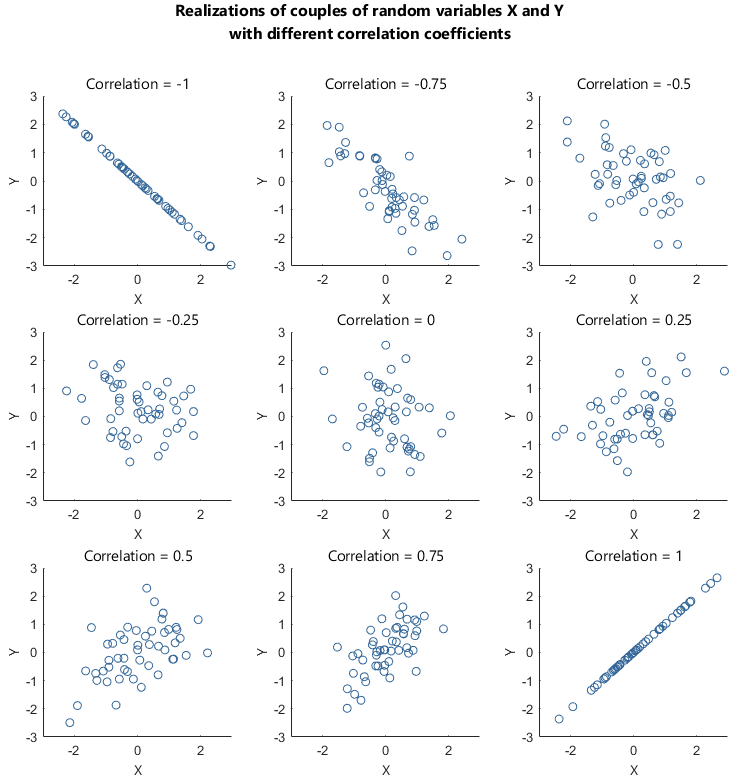

Let
 and
be two random variables.
and
be two random variables.
The linear correlation coefficient (or Pearson's correlation
coefficient) between
and
is
where:
is the covariance between
and
;
and
are the standard deviations of
and
.
The linear correlation coefficient is well-defined only as long as
,
and
exist and are well-defined.
It is often denoted by
.
In principle, the ratio is well-defined only if
and
are strictly greater than zero.
However, it is often assumed that
when one of the two standard deviations is zero.
This is equivalent to assuming that
because
when one of the two standard deviations is zero.
The interpretation is similar to the interpretation of covariance: the
correlation between
and
provides a measure of how similar their deviations from the respective means
are (see the lecture on Covariance for a detailed
explanation).
Linear correlation ranges between
and
:
Thanks to this property, correlation allows us to easily understand the intensity of the linear dependence between two random variables:
the closer correlation is to
,
the stronger the positive linear dependence between
and
is;
the closer it is to
,
the stronger the negative linear dependence between
and
is.
The following terminology is often used:
If
then
and
are said to be positively linearly correlated (or simply
positively correlated).
If
then
and
are said to be negatively linearly correlated (or simply
negatively correlated).
If
then
and
are said to be linearly correlated (or simply
correlated).
If
then
and
are said to be uncorrelated. Also note that
.
Therefore, two random variables
and
are uncorrelated whenever
.
In this example we show how to compute the coefficient of linear correlation between two discrete random variables.
Let
be a
-dimensional
random vector and denote its entries by
and
.
Let the support of
be
and
its joint probability
mass function
be
The support of
isand
its probability mass
function
is
The expected value of
is
The expected value of
is
The variance of
is
The standard deviation of
is
The support of
is:and
its probability mass function
is
The expected value of
is
The expected value of
is
The variance of
is
The standard deviation of
is
Using the transformation
theorem, we can compute the expected value of
:![[eq34]](/images/linear-correlation__80.png)
Hence, the covariance between
and
is![[eq35]](/images/linear-correlation__83.png) and
the linear correlation coefficient
is
and
the linear correlation coefficient
is![[eq36]](/images/linear-correlation__84.png)
The following sections contain more details about the linear correlation coefficient.
Let
be a random variable,
then
This is proved as
follows:where
we have used the fact
that
The linear correlation coefficient is
symmetric:
This is proved as
follows:where
we have used the fact that covariance is
symmetric:
Below you can find some exercises with explained solutions.
Let
be a
discrete random vector and denote its components by
and
.
Let the support of
beand
its joint probability mass function
be
Compute the coefficient of linear correlation between
and
.
The support of
isand
its marginal
probability mass function
isThe
expected value of
isThe
expected value of
isThe
variance of
isThe
standard deviation of
isThe
support of
isand
its marginal probability mass function
isThe
expected value of
isThe
expected value of
isThe
variance of
isThe
standard deviation of
isUsing
the transformation theorem, we can compute the expected value of
:Hence,
the covariance between
and
isand
the coefficient of linear correlation between
and
is
Let
be a
discrete random vector and denote its entries by
and
.
Let the support of
beand
its joint probability mass function
be
Compute the coefficient of linear correlation between
and
.
The support of
isand
its marginal probability mass function
isThe
mean of
isThe
expected value of
isThe
variance of
isThe
standard deviation of
isThe
support of
isand
its probability mass function
isThe
mean of
isThe
expected value of
isThe
variance of
isThe
standard deviation of
isThe
expected value of the product
can
be derived using the transformation
theorem![[eq74]](/images/linear-correlation__163.png) Therefore,
putting pieces together, the covariance between
and
isand
the coefficient of linear correlation between
and
is
Therefore,
putting pieces together, the covariance between
and
isand
the coefficient of linear correlation between
and
is
Let
be a continuous
random vector with support
and
let its joint probability density function
be![[eq79]](/images/linear-correlation__172.png)
Compute the coefficient of linear correlation between
and
.
The support of
isWhen
,
the marginal
probability density function of
is
,
while, when
,
the marginal probability density function of
can be obtained by integrating
out of the joint probability density as
follows:Thus,
the marginal probability density function of
isThe
expected value of
isThe
expected value of
isThe
variance of
isThe
standard deviation of
isThe
support of
isWhen
,
the marginal probability density function of
is
,
while, when
,
the marginal probability density function of
can be obtained by integrating
out of the joint probability density as
follows:We
do not explicitly compute the integral, but we write the marginal probability
density function of
as
follows:The
expected value of
is![[eq90]](/images/linear-correlation__206.png) The
expected value of
is
The
expected value of
is![[eq91]](/images/linear-correlation__208.png) The
variance of
isThe
standard deviation of
isThe
expected value of the product
can be computed by using the transformation
theorem:
The
variance of
isThe
standard deviation of
isThe
expected value of the product
can be computed by using the transformation
theorem:![[eq94]](/images/linear-correlation__214.png) Hence,
by the covariance formula, the covariance between
and
isand
the coefficient of linear correlation between
and
is
Hence,
by the covariance formula, the covariance between
and
isand
the coefficient of linear correlation between
and
is
Please cite as:
Taboga, Marco (2021). "Linear correlation", Lectures on probability theory and mathematical statistics. Kindle Direct Publishing. Online appendix. https://www.statlect.com/fundamentals-of-probability/linear-correlation.
Most of the learning materials found on this website are now available in a traditional textbook format.
