The Gamma distribution is a generalization of the Chi-square distribution.
It plays a fundamental role in statistics because estimators of variance often have a Gamma distribution.

Table of contents
There are several equivalent parametrizations of the Gamma distribution.
We present one that is particularly convenient in Bayesian applications, and we discuss how it maps to alternative parametrizations.
In our presentation, a Gamma random variable
 has two parameters:
the mean parameter
,
which determines the expected value of the
distribution:
the degrees-of-freedom parameter
,
which determines the variance of the distribution together with
:
Let
be independent normal random variables with zero mean and unit variance.
The variable
has
a Chi-square distribution with
degrees of freedom.
If
is a strictly positive constant, then the random variable
defined as
has
a Gamma distribution with parameters
and
.
Therefore, a Gamma variable
with parameters
and
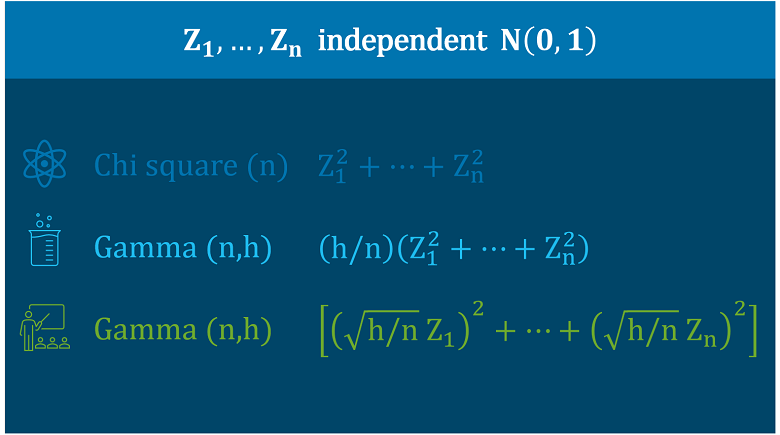
can also be written as the sum of the squares of
independent normals having zero mean and variance equal to
:
In general, the sum of independent squared normal variables that have zero mean and arbitrary variance has a Gamma distribution.
Yet another way to see
is as the sample variance of
normal variables with zero mean and variance
:
Gamma random variables are characterized as follows.
Definition
Let
be a continuous
random variable. Let its
support be the set
of positive real
numbers:Let
.
We say that
has a Gamma distribution with parameters
and
if and only if its
probability density
function
iswhere
is a
constant:and
is the Gamma function.
To better understand the Gamma distribution, you can have a look at its density plots.
Here we discuss two alternative parametrizations reported on Wikipedia. You can safely skip this section on a first reading.
The first alternative parametrization is obtained by setting
and
,
under which:
the density on the support
is
the mean
is
the variance
is
The second alternative parametrization is obtained by setting
and
,
under which:
the density on the support
is
the mean
is
the variance
is
Although these two parametrizations yield more compact expressions for the density, the one we present often generates more readable results when it is used in Bayesian statistics and in variance estimation.
The expected value of a Gamma random variable
is
The
mean can be derived as
follows:![[eq21]](/images/gamma-distribution__47.png)
The variance of a Gamma random variable
is
It
can be derived thanks to the usual
variance formula
():![[eq24]](/images/gamma-distribution__51.png)
The moment generating function of a Gamma random
variable
is defined for any
:
By
using the definition of moment generating function, we
obtain![[eq26]](/images/gamma-distribution__55.png) where
the integral equals
because it is the integral of the probability density function of a Gamma
random variable with parameters
and
.
Thus,Of
course, the above integrals converge only if
,
i.e. only if
.
Therefore, the moment generating function of a Gamma random variable exists
for all
.
where
the integral equals
because it is the integral of the probability density function of a Gamma
random variable with parameters
and
.
Thus,Of
course, the above integrals converge only if
,
i.e. only if
.
Therefore, the moment generating function of a Gamma random variable exists
for all
.
The characteristic function of a Gamma random
variable
is
It can be derived by using the definition of
characteristic function and a Taylor series
expansion:![[eq31]](/images/gamma-distribution__65.png)
The distribution function
of a Gamma random variable
iswhere
the
functionis
called lower incomplete Gamma function and is
usually evaluated using specialized computer algorithms.
This is proved as
follows:![[eq34]](/images/gamma-distribution__68.png)
In the following subsections you can find more details about the Gamma distribution.
If a variable
has the Gamma distribution with parameters
and
,
thenwhere
has a Chi-square distribution with
degrees of freedom.
For notational simplicity, denote
by
in what follows. Note that
is
a strictly increasing function of
,
since
is strictly positive. Therefore, we can use the formula for the
density of an increasing function of a
continuous
variable:The
density function of a Chi-square random variable with
degrees of freedom
iswhere
Therefore,![[eq40]](/images/gamma-distribution__84.png) which
is the density of a Gamma distribution with parameters
and
.
which
is the density of a Gamma distribution with parameters
and
.
Thus, the Chi-square distribution is a special case of the Gamma distribution
because, when
,
we
have
In other words, a Gamma distribution with parameters
and
is just a Chi square distribution with
degrees of freedom.
By multiplying a Gamma random variable by a strictly positive constant, one obtains another Gamma random variable.
If
is a Gamma random variable with parameters
and
,
then the random variable
defined
ashas
a Gamma distribution with parameters
and
.
This can be easily seen using the result
from the previous
subsection:where
has a Chi-square distribution with
degrees of freedom.
Therefore,In
other words,
is equal to a Chi-square random variable with
degrees of freedom, divided by
and multiplied by
.
Therefore, it has a Gamma distribution with parameters
and
.
In the lecture on the Chi-square distribution, we
have explained that a Chi-square random variable
with
degrees of freedom
(
integer) can be written as a sum of squares of
independent normal random variables
,
...,
having mean
and variance
:
In the previous subsections we have seen that a variable
having a Gamma distribution with parameters
and
can be written
aswhere
has a Chi-square distribution with
degrees of freedom.
Putting these two things together, we
obtainwhere
we have
defined
But the variables
are normal random variables with mean
and variance
.
Therefore, a Gamma random variable with parameters
and
can be seen as a sum of squares of
independent normal random variables having zero mean and variance
.
We now present some plots that help us to understand how the shape of the Gamma distribution changes when its parameters are changed.
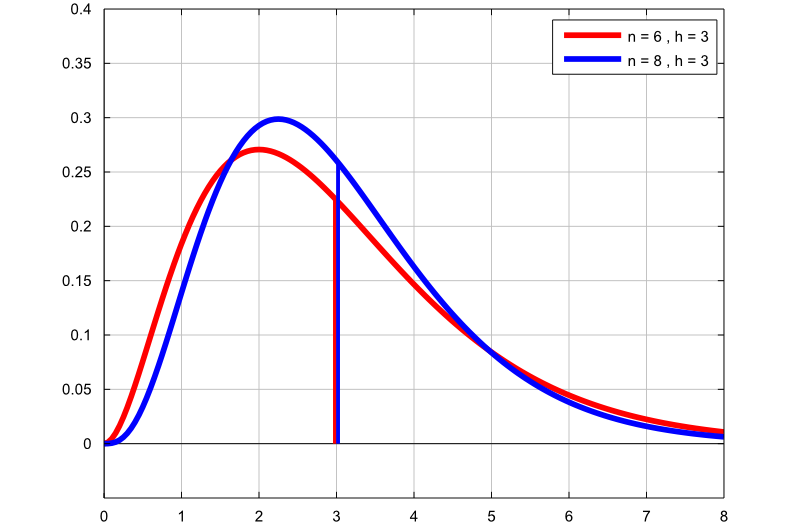
The following plot contains two lines:
the first one (red) is the pdf of a Gamma random variable with
degrees of freedom and mean
;
the second one (blue) is obtained by setting
and
.
Because
in both cases, the two distributions have the same mean.
However, by increasing
from
to
,
the shape of the distribution changes. The more we increase the degrees of
freedom, the more the pdf resembles that of a normal distribution.
The thin vertical lines indicate the means of the two distributions.
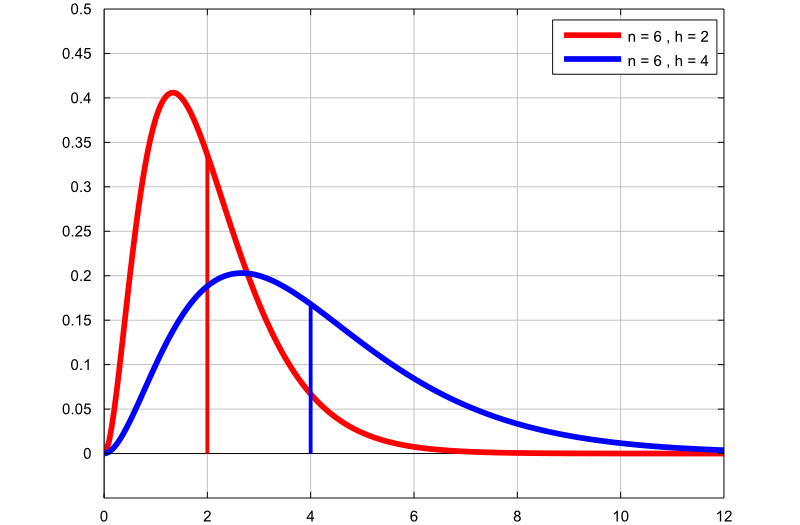
In this plot:
the first line (red) is the pdf of a Gamma random variable with
degrees of freedom and mean
;
the second one (blue) is obtained by setting
and
.
Increasing the parameter
changes the mean of the distribution from
to
.
However, the two distributions have the same number of degrees of freedom
().
Therefore, they have the same shape. One is the "stretched version of the
other". It would look exactly the same on a different scale.
Below you can find some exercises with explained solutions.
Let
and
be two independent Chi-square random variables having
and
degrees of freedom respectively.
Consider the following random
variables:
What distribution do they have?
Being multiples of Chi-square random
variables, the variables
,
and
all have a Gamma distribution. The random variable
has
degrees of freedom and the random variable
can be written
aswhere
.
Therefore
has a Gamma distribution with parameters
and
.
The random variable
has
degrees of freedom and the random variable
can be written
aswhere
.
Therefore
has a Gamma distribution with parameters
and
.
The random variable
has a Chi-square distribution with
degrees of freedom, because
and
are independent (see the lecture on the
Chi-square distribution), and the random
variable
can be written
aswhere
.
Therefore
has a Gamma distribution with parameters
and
.
Let
be a random variable having a Gamma distribution with parameters
and
.
Define the following random
variables:
What distribution do these variables have?
Multiplying a Gamma random variable by a
strictly positive constant one still obtains a Gamma random variable. In
particular, the random variable
is a Gamma random variable with parameters
and
The random variable
is a Gamma random variable with parameters
and
The random variable
is a Gamma random variable with parameters
and
The
random variable
is also a Chi-square random variable with
degrees of freedom (remember that a Gamma random variable with parameters
and
is also a Chi-square random variable when
).
Let
,
and
be mutually independent normal random
variables having mean
and variance
.
Consider the random
variable
What distribution does
have?
The random variable
can be written as
where
,
and
are mutually independent standard normal random
variables. The sum
has a Chi-square distribution with
degrees of freedom (see the lecture entitled
Chi-square distribution). Therefore
has a Gamma distribution with parameters
and
.
Please cite as:
Taboga, Marco (2021). "Gamma distribution", Lectures on probability theory and mathematical statistics. Kindle Direct Publishing. Online appendix. https://www.statlect.com/probability-distributions/gamma-distribution.
Most of the learning materials found on this website are now available in a traditional textbook format.
